
 Book a migration call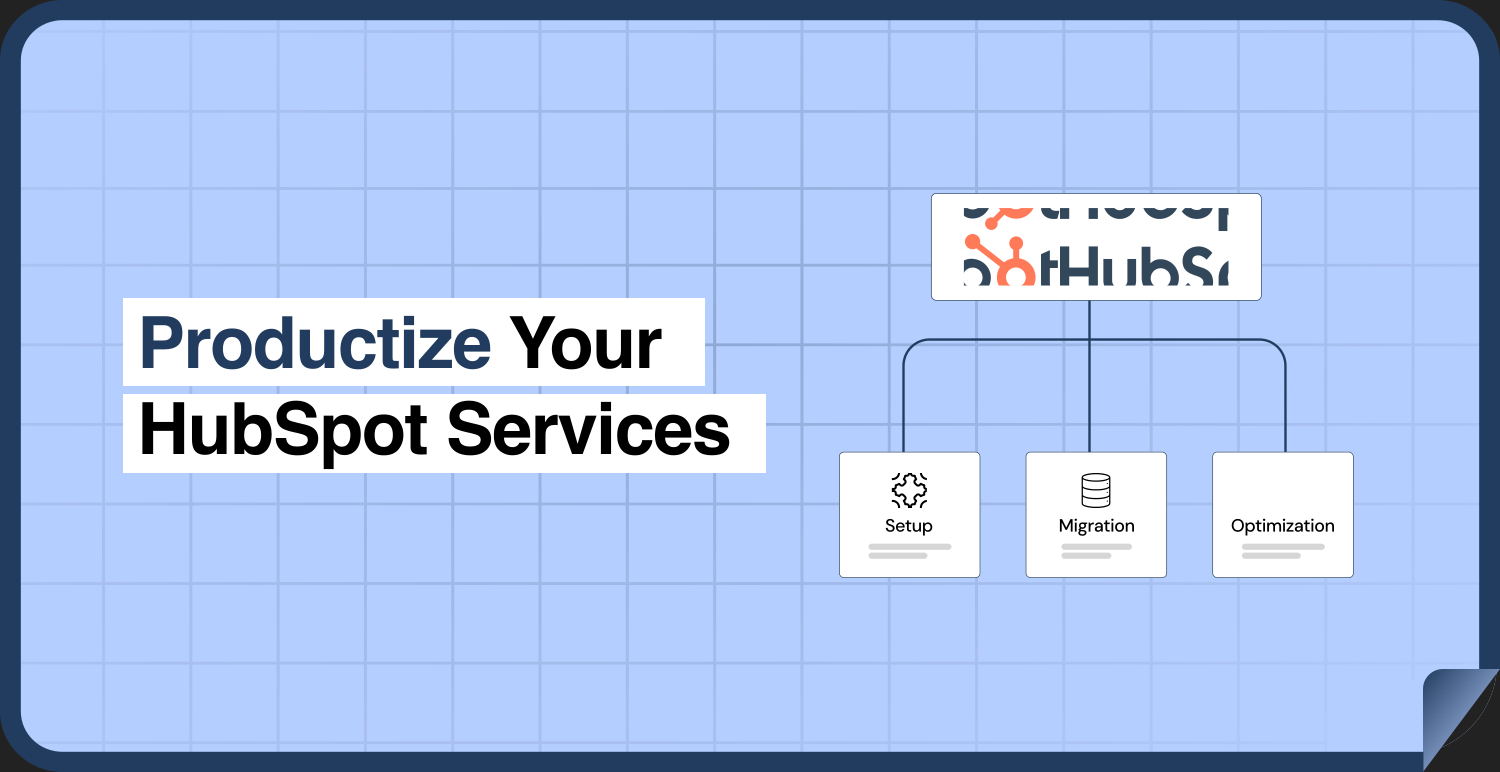

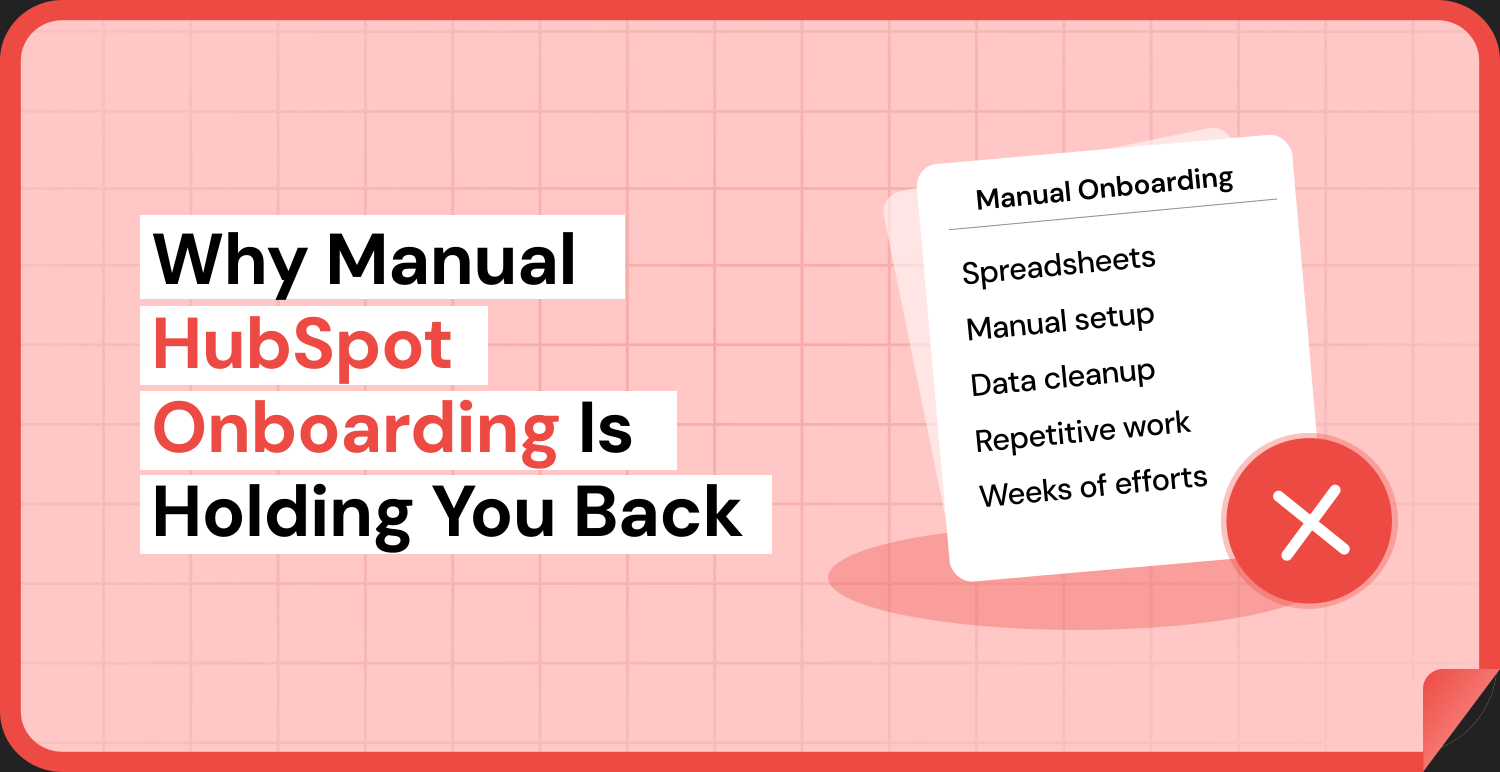
Your senior admin just spent a day and a half building a Sales Hub instance for a B2B SaaS client. Properties, three pipelines with deal stages, ten workflows, lead routing, permission sets. Next week another SaaS client signs, and someone on your team builds nearly the same thing again. Different naming conventions, a slightly different pipeline structure, maybe a missed required-field setting that won’t surface until the client’s reps are three weeks into using the instance. You’ve now built the same foundation twice, billed for two full builds, and shipped two subtly different results.
That’s the tax most HubSpot agencies pay without naming it. Every onboarding is a snowflake, rebuilt from scratch by whoever’s free. It caps your margin, ties delivery quality to individual admin skill, and forces you to hire another admin every time you want to grow. The way out is to productize your HubSpot agency service. Standardize the 70-80% of every implementation that’s actually identical, deploy it as repeatable modules, and let your team spend billable hours on the custom work clients will pay a premium for.
This is a playbook for making that shift. It’s opinionated, because I’ve run it, and because the agencies that don’t make it stay stuck selling time instead of outcomes.
Why Bespoke HubSpot Delivery Caps Your Agency’s Margin
When you price by the hour and every build is bespoke, you’ve built a business with no ceiling on cost and no floor on speed. There’s no incentive to get faster, because faster means fewer billable hours. And there’s no limit on how long a “simple” onboarding can drag, because scope creep has nowhere to catch.
Here’s the math that should bother you. A standard Sales Hub onboarding, properties, property groups, a two-to-three pipeline setup with deal stages, eight to twelve core workflows, lead routing, and permission sets, takes an experienced admin 1.5 to 2 days to build manually in production.[1] Run 30 to 40 of those a year and you’re spending 60 to 80 admin days annually just re-creating the same foundation. That’s not strategy. That’s not process design. That’s typing the same configuration into a fresh portal over and over.
The second problem is quality variance. Your senior admin ships a clean instance. Your junior ships one with orphaned properties, a half-configured workflow, and a deal stage mapped to the wrong pipeline. There’s no repeatable standard, so client outcomes depend entirely on who happened to be free that week. QA eats hours you can’t bill, and the errors you miss become live-data cleanup projects after the client’s reps are already working in the instance.
The third problem is the capacity ceiling. Growth means more clients, more clients means more admin hours, and more admin hours means hiring another HubSpot admin. That’s a $70-95K loaded cost with a 6-8 week ramp before they’re productive on your standards.[2] Your delivery scales linearly with headcount. That’s the opposite of what a productized business looks like.
The 70/30 Split: What’s Actually Repeatable in a HubSpot Build
The single most useful thing I can tell you is this: roughly 70-80% of any given Hub implementation is structurally identical across clients in the same segment.[3] A B2B SaaS Sales Hub looks fundamentally like every other B2B SaaS Sales Hub. Professional services firms share a pipeline shape. The lead lifecycle stages, the core deal properties, the notification workflows, the permission tiers, these repeat.
The genuinely custom work, client-specific properties, a unique pipeline stage that maps to their actual sales motion, a bespoke integration, is the remaining 20-30%. That’s the part that justifies expert hours and premium billing.
Agencies that don’t separate these two layers rebuild the standard 70% every single time, which is where the 60-80 wasted days come from. The move is to codify the 70% once, deploy it consistently, and then spend your admin’s brain on the 30% that actually needs a brain.
Do this segment by segment. You don’t need one universal template. You need a defined standard B2B SaaS Sales Hub, a standard professional services Service Hub, and so on. Each one is a reusable asset. Each one is the raw material of a productized SKU.
Standardizing Your Modules: Building the Config Once
Standardization only works if the standard lives somewhere other than a senior admin’s head. If your “best practice” is a Notion doc people follow when they remember to, you don’t have a standard. You have a suggestion.
This is what SuprConfig is built for. You define a fully configured Hub module once, properties, property groups, pipelines, deal stages, workflows, and user permissions, and CONFIG codifies it as a deployable unit. Instead of a checklist someone re-types, your standard B2B SaaS Sales Hub becomes an actual artifact you can deploy on demand.
The immediate payoff is speed. Suprdense CONFIG’s one-click hub deployment stands up that fully configured module in one action. Against the manual 1.5-2 day build, that’s twelve minutes versus two days.[4] But speed is almost the smaller benefit. The bigger one is that delivery quality decouples from who’s available.
Because the standard is codified in CONFIG rather than reconstructed from memory, a junior deploys the same clean build your senior would have. The orphaned properties and half-configured workflows disappear, not because your junior got better overnight, but because they’re no longer building the foundation by hand. Your senior’s expertise is captured in the module once, then reused indefinitely.
Let me be precise about what this does and doesn’t do. Suprdense CONFIG deploys and standardizes configuration. It does not design the client’s business process for you. Deciding which pipeline stages match a given client’s sales motion is still expert work. CONFIG removes the mechanical rebuild, not the thinking. That’s the honest boundary, and it’s also exactly the right division of labor: automate the mechanical, bill for the strategic.
From Sandbox to Production Without the Rebuild
Here’s a failure mode every agency knows. You build and test in a sandbox, get client sign-off, then manually recreate the whole thing in production. You re-type the configs, and somewhere in the process you miss a workflow, mismatch a deal stage, or forget a required-field setting. The production instance never quite matches what was tested and approved. That’s config drift, and it’s insidious because the client signed off on something they’re not actually getting.
Suprdense CONFIG’s sandbox-to-production deployment kills this. It moves a tested, signed-off configuration from sandbox to production without manual re-creation. What you QA’d is what goes live: the same properties, the same pipelines, the same workflows, deployed as a unit rather than rebuilt by hand.
This matters more than it sounds. The gap between “what we tested” and “what we shipped” is where a huge share of post-launch support tickets start.[5] Eliminating the manual re-creation step eliminates an entire category of errors that otherwise surface only after the client is live and using the data.
Packaging the Service: Turning Standardized Builds into Fixed-Scope SKUs
You can’t sell a fixed-price onboarding package when the underlying build is bespoke and open-ended. Fixed-scope pricing requires a fixed-scope deliverable. Module standardization is what makes that possible.
Once your standard B2B SaaS Sales Hub is a codified, one-click deployment, it becomes a line item your sales team can actually quote with confidence. You know exactly what it includes and exactly how long it takes to deliver. Build tiers on top of it: a foundation package that’s the standard module deployed and lightly tailored, a mid tier that adds a defined set of custom properties and workflows, a premium tier for clients whose process needs real custom design.
This is the actual mechanism of productization. You’re not selling “however many hours it takes.” You’re selling a defined outcome at a defined price, delivered predictably, because the 70% that used to eat your margin now takes twelve minutes.
The Margin and Capacity Math
Run the numbers on your own shop. An agency doing 30 onboardings a year that cuts standard-module build time from about 2 days to under an hour per client reclaims roughly 50+ billable-equivalent days annually.[6] That’s capacity that can absorb an estimated 15-20 additional clients without a new hire.
Compare that to the hiring alternative. A mid-level HubSpot admin runs $70-95K loaded and takes 6-8 weeks to become productive on your specific standards.[2] Deployment automation converts that headcount cost into a tooling cost. Unlike a new hire, the tooling doesn’t need a ramp period and doesn’t produce variable-quality output.
The strategic point: your delivery capacity stops scaling with headcount and starts scaling with tooling. That’s the difference between an agency that grows margin as it grows revenue and one that watches margin flatten because every new client requires proportional new labor.
Where Custom Work Still Belongs
Productizing does not mean automating everything, and any vendor who tells you it does is selling you a problem. The 20-30% that’s genuinely custom, the client-specific pipeline stage that mirrors their actual sales motion, the integration with their billing system, the property architecture that reflects how they actually segment accounts, should not be productized. It should be priced as premium scope.
This is the healthy version of the model. You use Suprdense CONFIG for the standardized 70-80%, which removes the low-value mechanical rebuild. Then you spend your admin’s expensive, expert hours on the 30% that actually justifies them, and you bill that work accordingly, because it’s the part clients recognize as real strategic value.
The agencies that get this right don’t feel like they’ve commoditized their service. They feel like they’ve stopped giving away the mechanical work for free and started charging properly for the thinking.
Frequently Asked Questions
Doesn’t productizing mean every client gets the same generic setup?
No. You standardize the foundation and layer client-specific configuration on top. The standard module handles the 70-80% that’s genuinely identical across clients in a segment: the lifecycle stages, core properties, notification workflows, permission tiers. The client-specific 20-30% is where you still do custom work. A productized service isn’t a generic service. It’s a service where you stopped rebuilding the identical parts by hand so you could spend more attention on the parts that are actually unique.
How do we handle clients whose sales process genuinely doesn’t fit our standard module?
Two paths. If the deviation is moderate, deploy the standard module with Suprdense CONFIG first, then modify. It’s far faster to adjust a deployed foundation than to build from zero. If the client’s process is fundamentally different from your segment standard, that’s a signal it belongs in a premium, custom-scoped tier, priced accordingly. The key is that CONFIG makes the deploy-then-modify path fast enough to be the right default for most clients, and you reserve full custom builds for the genuine outliers.
What happens if our standard module changes, do we have to redeploy every client?
No. A CONFIG deployment stands up a configuration in a client’s portal at a point in time. It doesn’t create a live dependency that changes when you update your template. When you improve your standard module, new deployments get the new version. Already-live client instances stay as they are unless you deliberately choose to apply changes. This means you can evolve your standard over time without disrupting instances that are already in production.
How much of a HubSpot onboarding can realistically be automated?
The mechanical build, properties, property groups, pipelines, deal stages, workflows, permission sets, is what Suprdense CONFIG’s one-click hub deployment handles. That’s the 70-80% that repeats. What isn’t automated, and shouldn’t be, is the strategic scoping: understanding the client’s sales motion, deciding which pipeline stages reflect reality, designing the custom pieces. CONFIG removes the rebuild, not the thinking. Anyone promising full automation of an onboarding is overselling.
Do we need a senior HubSpot admin to set this up, or can juniors run deployments?
Both, in the right roles. Your senior admin defines the standard module once. That’s expert work, encoding your best-practice build into Suprdense CONFIG. After that, a junior can run the one-click deployment and get the same quality result, because the expertise lives in the codified module rather than in the person clicking the button. That division is the whole point: you capture senior-level quality once and deploy it at junior-level cost.
Conclusion
The agencies stuck at a margin ceiling all share the same habit. They rebuild the identical 70% of every HubSpot instance by hand, every time, and call it delivery. It’s not delivery, it’s re-typing. And it’s the single biggest drag on both margin and quality that a HubSpot agency carries.
To productize your HubSpot agency service is to draw a clean line between the standardizable foundation and the genuinely custom work, codify the foundation once, and deploy it consistently. Suprdense CONFIG is the mechanism that makes that line real: one-click hub deployment for the standard modules, sandbox-to-production deployment that kills config drift, and repeatable quality that no longer depends on who’s free that week. The custom 20-30% stays custom, priced as premium scope, done by experts.
Start with one segment and one Hub. Define your standard B2B SaaS Sales Hub, deploy it in twelve minutes instead of two days, and package it as a fixed-scope SKU. Then count the days you get back. That reclaimed capacity is the difference between hiring your next admin and absorbing your next fifteen clients without one.
Frequently Asked Questions
01 What does it mean to productize HubSpot agency services?
Productizing HubSpot agency services means turning repeatable implementation work into standardized, fixed-scope packages with defined deliverables, pricing, and timelines. Agencies reuse proven configuration modules while reserving custom process design and integrations for premium services.
02 How can a HubSpot agency scale without hiring more admins?
A HubSpot agency can scale by standardizing recurring configurations, automating deployment, and reducing manual setup across client portals. Suprdense CONFIG helps agencies deploy reusable HubSpot modules, freeing senior admins to focus on strategy and complex client requirements.
03 How much of a HubSpot implementation can be standardized?
According to the article, approximately 70–80% of an implementation can be standardized for clients within the same segment. This typically includes properties, property groups, pipelines, deal stages, workflows, and permission sets. The remaining 20–30% involves client-specific requirements.
04 How does HubSpot deployment automation improve agency profit margins?
Deployment automation reduces repetitive admin hours, improves configuration consistency, and increases delivery capacity without proportional increases in headcount. Agencies can use the time saved to serve more clients and focus billable hours on higher-value strategic work.
05 How can HubSpot agencies offer fixed-price onboarding packages?
Agencies can create fixed-price onboarding packages by defining a standardized configuration baseline, specifying included deliverables, and setting clear boundaries for customization. A tiered model can offer a standard deployment, an enhanced package with additional properties and workflows, and a premium tier for custom process design.
References
- HubSpot Solutions Partner Program, “Implementation and Onboarding Delivery Benchmarks,” HubSpot Partner Resources, 2023.
- Glassdoor and Payscale aggregated compensation data, “HubSpot Administrator Salary and Ramp Benchmarks,” 2023-2024.
- Diginomica / RevOps practitioner surveys, “Standardization Patterns in CRM Implementation,” 2023.
- Suprdense internal deployment benchmarks, “Manual vs. CONFIG Hub Build Timings,” 2024.
- Zendesk, “Post-Launch Support Ticket Analysis in CRM Implementations,” Customer Experience Trends Report, 2023.
- Agency Operations Report, “Delivery Efficiency and Capacity Modeling for HubSpot Partners,” 2024.